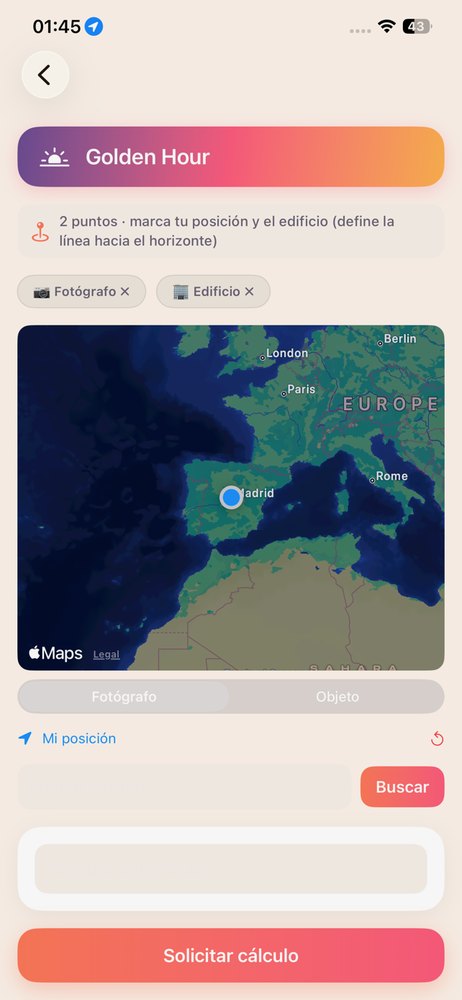
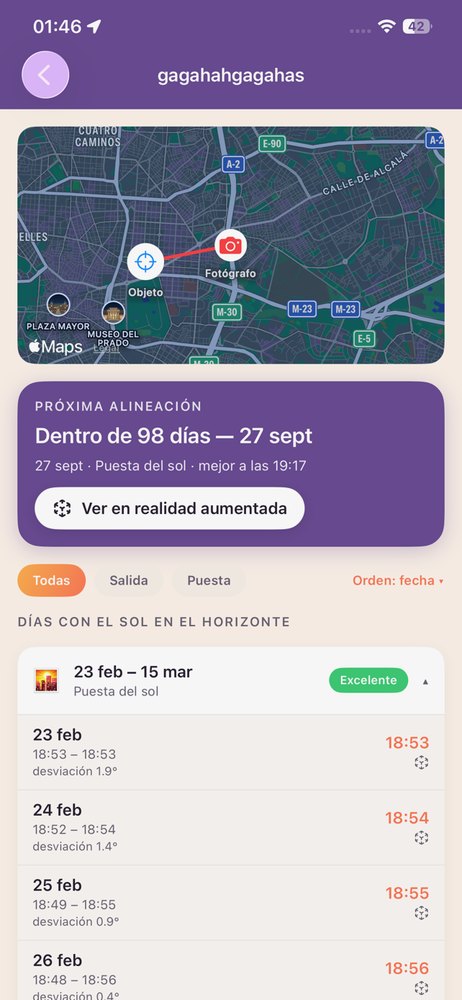
Before a solar or lunar eclipse, the big question is whether you will get a good view from your spot. Timelyshot tells you, point by point and at the exact time.
An eclipse does not look the same everywhere: it depends on where you are and how high the Sun or Moon sits at that moment. Timelyshot calculates, for the exact point you pick on the map, whether the eclipse will be visible and how.
What the app calculates
You pick the point on the map from which you want to watch the eclipse. Timelyshot gives you the exact time of maximum, the percentage of obscuration of the Sun (or coverage of the Moon) and the height of each body above the horizon at that instant.
On top of that, a map shows the visibility band of each eclipse: where it is seen at its fullest and where it is barely noticeable.
Pick a point and discover how the eclipse will look from there.
How to read the result
Type from your pointWhether from there the eclipse will be total, partial, annular or penumbral (or not visible at all).
Time of maximumThe exact instant when the eclipse reaches its peak at your position.
ObscurationWhat percentage of the Sun will be hidden (or of the Moon covered by the Earth s shadow).
ContactsThe start, maximum and end times of each phase of the eclipse.
Height above the horizonHow high the Sun or Moon will be: if it is low, near the horizon, watch out for obstacles.
Watch out for obstacles
If the eclipse happens with the Sun or Moon low, a building or a mountain can block it. That is why Timelyshot adds augmented reality:
Point the camera at the sky and you will see, overlaid, where the Sun will be on eclipse day.
That way you instantly check whether you will have a clear view from your spot or need to find another point.
With the camera you see where the eclipse will rise over the real landscape.
Tip: the catalog includes the eclipses from 2026 to 2030. Check them ahead of time and pick the best spot to watch them.
The eclipses ahead: Spain's trio (2026–2028)
Spain is living through a historic run: three solar eclipses in three consecutive years, something that won't happen again for over a century. In all three, the key question is the one Timelyshot answers: from your exact spot, will the Sun be high enough and the horizon clear?
12 August 2026 · Total eclipse
Where it's totalA band crosses northern Spain, from the Atlantic to the Mediterranean: A Coruña, Oviedo, Santander, Bilbao, León, Palencia, Burgos, Valladolid and Zaragoza; then over the sea, Valencia and Palma de Mallorca.
DurationTotality lasts at most around 2 min 18 s.
The challengeThe Sun will sit very low — about 11° above the western horizon when the shadow reaches Galicia, around 20:26 local time. Madrid and Barcelona see 99.9% (partial). With the Sun so close to the horizon, a hill or a building can block it: check your western horizon before choosing a spot.
2 August 2027 · Total eclipse
Where it's totalThe band crosses the south, over the Strait of Gibraltar: Cádiz, Málaga, Ceuta and Melilla, plus North Africa.
DurationOne of the longest of the century: totality reaches about 4 min 48 s in Ceuta.
The challengeIt happens in the morning with the Sun higher than in 2026, but it's worth checking its position from your spot to frame it against the landscape.
26 January 2028 · Annular eclipse
Where it's annularThe band of annularity (the "ring of fire") crosses from southwest to northeast: Seville, Málaga, Murcia and Valencia.
WhenRight before sunset, with the Sun very low.
The challengeWith the Sun almost touching the horizon, a clear western horizon is essential. This is the case where checking in advance whether a mountain or building will get in the way helps most.
Figures are indicative, based on official ephemerides (Spain's National Geographic Institute and observatories). Open each date in Timelyshot, mark your spot and you'll see the time of maximum, the body's altitude and whether any obstacle will block it.